Kenmore’s First Parish and a Legacy of Faith Since 1897
When visitors gather at St. Paul Roman Catholic Church for Buffalo Mass Mob LX, they will encounter far more than a beautiful parish church. They stand at one of the oldest institutions in the Village of Kenmore, a parish whose history predates the village itself and whose story mirrors the growth of one of Western New York’s most recognizable suburban communities.
Founded on May 10, 1897, St. Paul Parish was established by the Diocese of Buffalo to serve Catholic families living north of the city. At the time, Kenmore had not yet been incorporated as a village. That would come two years later, in 1899. As a result, St. Paul emerged not only as a center of worship but also as one of the foundational institutions around which the future community would develop.
The Earliest Years
Catholic life in the area was challenging during the late nineteenth century. The region was still largely rural, and local Catholic families often traveled significant distances to attend Mass. Roads were primitive, transportation was limited, and winter weather frequently made travel difficult.
The establishment of St. Paul was made possible through the generosity and determination of local Catholics. Frank Mang Sr. donated three acres of land along with $1,000 toward construction of a church. At the time, only sixteen Catholic families lived in the immediate area. Together they helped erect the first church building, which was completed in 1898. Bishop James Quigley dedicated the church and reportedly referred to the parish as “St. Paul’s Beyond the Walls” because it stood beyond Buffalo’s city limits.
For more than a decade, the parish functioned without a resident pastor. Priests traveled from Buffalo to celebrate Mass. One of the earliest was Father Nelles of Canisius College, who was transported by horse and carriage each Sunday by local parishioners. During severe winter storms he often remained in Kenmore overnight because travel conditions made a return trip impossible.
A major step toward stability occurred in 1910 with the construction of a rectory, allowing St. Paul to maintain a permanent pastoral presence for the first time. The year 1910 would ultimately become one of the key dates recognized in the parish’s National Register nomination.
Building a Catholic School
Education quickly became central to parish life.
In 1899, only two years after the parish was founded, St. Paul opened a school staffed by the Sisters of the Third Order of St. Francis. The small school reflected the commitment of Western New York Catholics to providing faith-based education for their children. As Kenmore grew, so did enrollment. By 1923, the original facilities had become overcrowded.
Under the leadership of Rev. Ferdinand Bank, the parish embarked on an ambitious campaign to construct a larger school building. The result was one of the most significant educational buildings in Kenmore.
Designed by the noted architectural firm Bley & Lyman and completed in 1925, the new Collegiate Gothic school included classrooms, administrative offices, a gymnasium, meeting space, and an auditorium capable of seating 800 people. Approximately 190 students attended on opening day.
Growth continued almost immediately. In 1929, an additional floor and six classrooms were added to accommodate increasing enrollment. By 1966, attendance reached a remarkable 836 students, illustrating both the vitality of the parish and the appeal of Catholic education during the postwar era.
The school expanded again in 1962 with additional classrooms, a chapel, and living quarters for the religious sisters who staffed the school. The 1962 addition would become one of the final dates included within the property’s National Register period of significance.
Although St. Paul School closed in 2010, its impact remains profound. Thousands of students received their education there over more than a century of service. Today, the historic school building is being preserved through its conversion into senior housing, ensuring its continued contribution to the Kenmore community.
The Creation of the Present Church
As the parish expanded, the original church building could no longer accommodate the growing congregation.
One of the most influential leaders in parish history was Father Timothy Ring. Under his leadership, parishioners successfully eliminated a debt of approximately $135,000 by 1945. Following the ceremonial burning of the mortgage, attention turned toward construction of a larger church to meet the needs of a rapidly expanding Catholic population.
The fundraising effort was remarkably successful. By 1952, parishioners had raised nearly $600,000 toward a new church and related facilities. The respected Buffalo firm Mortimer J. Murphy Architects was selected to design the project. Construction began in December 1953. The new church was completed in 1954 and formally blessed by Bishop Burke, himself a former priest of St. Paul Parish. Approximately 1,000 people attended the ceremonies.
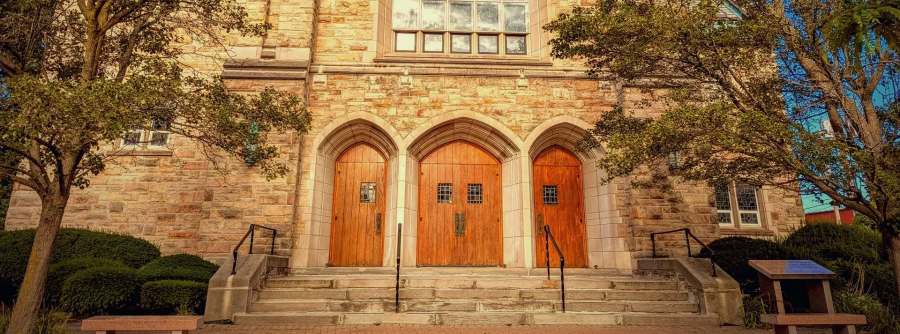
Constructed of Ohio sandstone with Indiana limestone trim, the church remains an impressive architectural landmark. Traditional Gothic Revival elements were blended with the cleaner forms associated with mid-twentieth-century ecclesiastical design, creating a structure that is both historic and distinctly modern for its era.
The new building incorporated several important elements from the original church. Among them were the Stations of the Cross that Father Ferdinand Bank had donated during the parish’s silver jubilee celebration in 1922. Crafted in Bavaria, they continue to connect worshipers with the parish’s earlier generations.
Pastors Who Shaped the Parish
While a complete roster of pastors requires consultation of parish archives and anniversary publications, several clergy stand out in the documented history of St. Paul.
Father Nelles provided pastoral care during the mission years before a resident priest was assigned.
Rev. Ferdinand Bank guided the parish through a period of educational expansion and led fundraising efforts for the landmark 1925 school.
Father Timothy Ring oversaw debt retirement and the ambitious building campaign that produced today’s church and rectory.
Father Paul Whitney established a restoration fund in the 1980s that helped secure the long-term preservation of the church complex.
Together with numerous associate pastors, religious sisters, deacons, and lay leaders, these clergy helped transform a small rural mission into one of Kenmore’s most enduring institutions.
National Register Recognition
The historical and architectural significance of St. Paul was formally recognized on July 11, 2022, when the St. Paul’s Roman Catholic Church Complex was listed on the National Register of Historic Places. The designation includes the church, rectory, school, and associated parish buildings. The National Register recognized the complex for its architectural significance and its importance in documenting the social history of Kenmore and the development of Catholic life in the community.
A Living Legacy
From sixteen founding families to thousands of parishioners over the generations, St. Paul has accompanied Kenmore through nearly every stage of its history. The parish witnessed the village’s incorporation, the rise of Catholic education, two world wars, the postwar suburban boom, and the changing face of Western New York.
Today, more than 125 years after its founding, St. Paul remains a vibrant parish community and a treasured historic landmark. Its story is one of sacrifice, generosity, faith, and perseverance. For Buffalo Mass Mob participants, a visit to St. Paul offers the opportunity to experience not only a beautiful church but also a living chapter in the Catholic history of Western New York.
Much of the historical information presented here was drawn from the National Register of Historic Places nomination for the St. Paul’s Roman Catholic Church Complex and parish records cited therein. Buffalo Mass Mob welcomes additional historical information, photographs, and memories from current and former parishioners to further document the rich history of this the parish. Please email to kristop11@gmail.com.
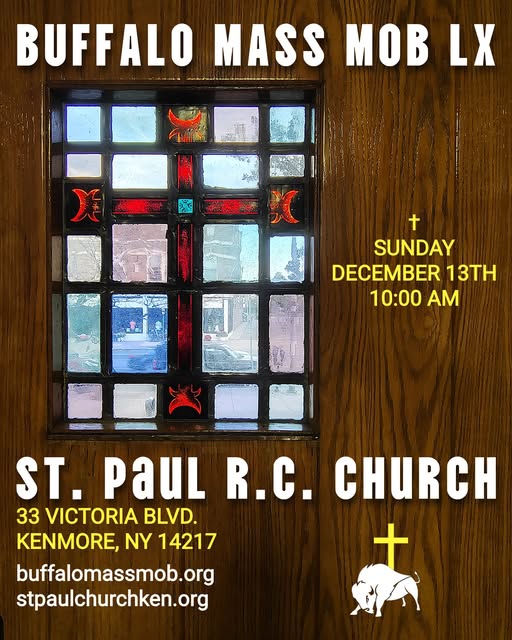
Please join us on Sunday, December 13 for Buffalo Mass Mob LX—->
Church website: https://www.stpaulchurchken.org/